Artsy Exclusive


A Long Train: 250 Years of Hypocrisy

On view February 22 to April 4, 2026

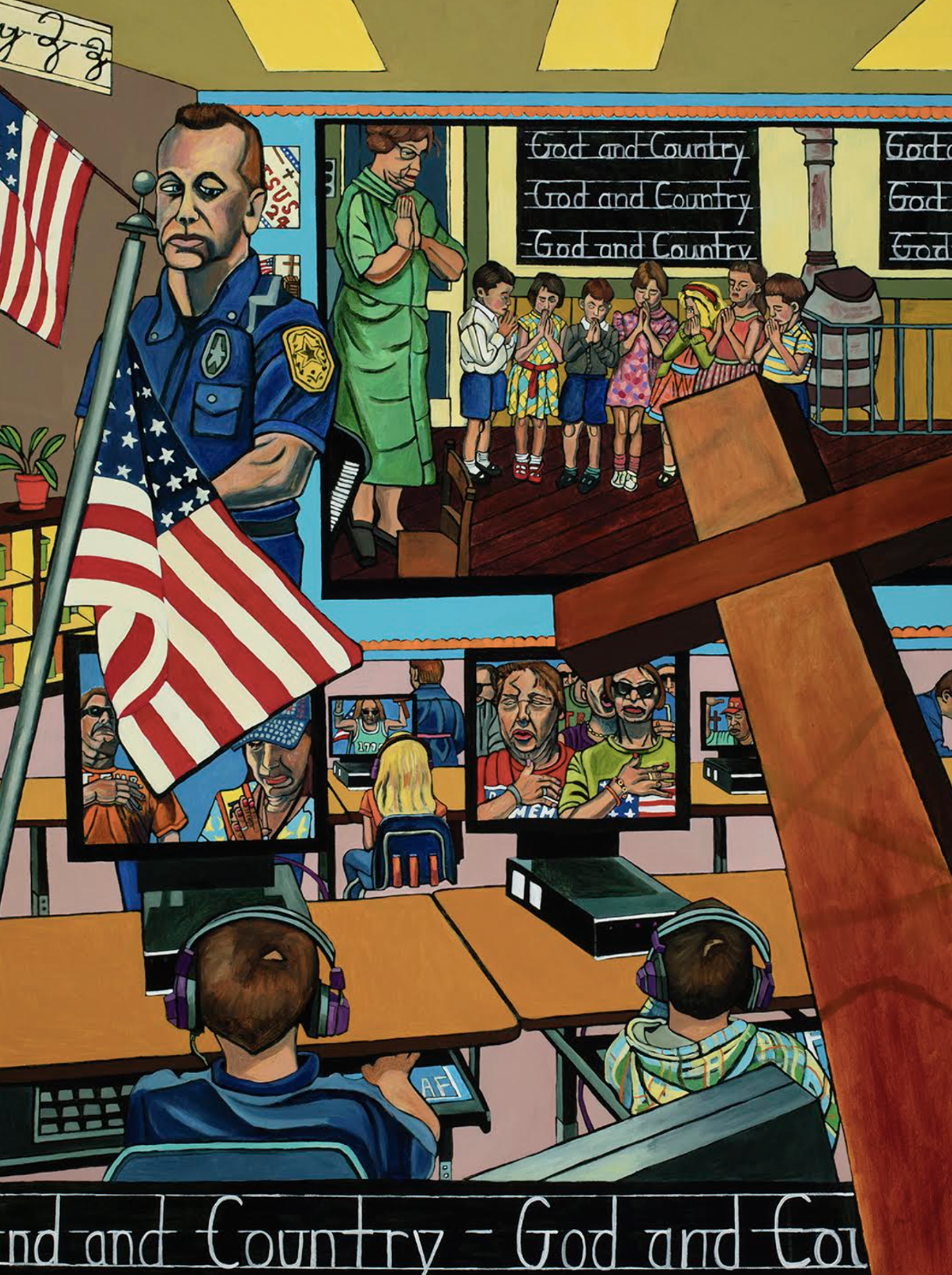
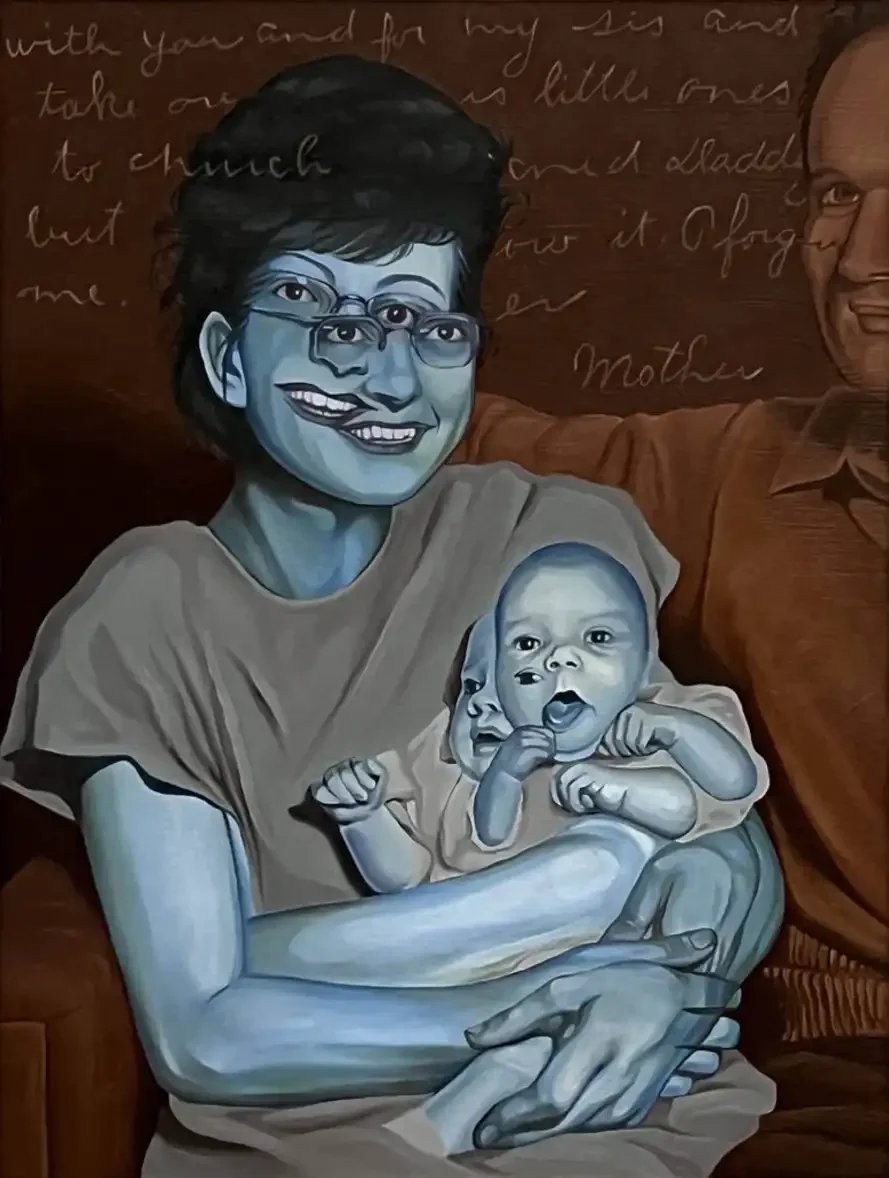
Myra Eastman, God & Country series: Morning Lessons, 2024, Acrylic on Canvas, 48x36”. Courtesy of the Artist.

Curated by Aaron Wilder, A Long Train: 250 Years of Hypocrisy is an online-only exhibition hosted by Amos Eno Gallery on Artsy.net, from February 22 to April 4, 2026. This exhibition invited artists to engage critically with the contradictions inherent in documents founding the United States of America and their legacy.

2026 marks the 250th anniversary of the Declaration of Independence. A Long Train: 250 Years of Hypocrisy examines the Declaration not as a completed achievement but as a continuing structure of selective freedom. While its authors depicted themselves as victims of “a long train of abuses and usurpations” by the King of England, the Declaration simultaneously enabled those same men to institutionalize the dispossession of Indigenous peoples, the enslavement of Africans, and the exclusion of women from political and social life. This exhibition foregrounds the contradictions of foundational American myths, interrogating who was included, who was erased, and what freedoms remain incomplete.

The show features 13 artists: Alexis Burdette, Cathleen Campbell, Myra Eastman, Lisa Kellner, Christopher James Kull, Cecil Lee, Peter Marcalus, Breanna Cee Martins, John Francis Peters, Monica J Rich, Rebecca Shmuluvitz, Niki Singleton, and KR Windsor. The work of each engages critically with themes inherent in the Declaration, collectively corresponding to the 13 original colonies and the groups of white male signers whose privileges were normalized in its text. Works range from painting, photography, and sculpture to mixed media and digital collage. Across these varied media, the artists examine how language, land, bodies, and histories are entangled, while also exploring acts of refusal, survival, imagination, and care.

Presented online via Amos Eno Gallery on Artsy.net, the exhibition also reflects on the material and commercial conditions of art circulation. Just as independence was bound up with property and capital, the works in this show circulate within contemporary systems of cultural and economic value. By exposing these entanglements (between celebration and critique, commerce and complicity) the exhibition positions itself as intervention, reflection, and dialogue rather than performance.

By centering both critique and possibility, A Long Train: 250 Years of Hypocrisy asks viewers to consider the legacies we inherit, the exclusions we perpetuate, and the visions of freedom that remain unfulfilled

In Return to Sender, Alexis Burdette stages a refusal at the site where the promises of the Declaration of Independence are most often rehearsed: the fantasy of arrival. A shackled figure, head cropped from view, holds out a gift wrapped in red, white, and blue against the backdrop of a prison wall crowned with barbed wire. The gesture is unmistakable: the “American Dream” is returned unopened. The Declaration’s assertion of “life, liberty and the pursuit of happiness” is exposed here as a conditional offering, one that has historically withheld liberty from those rendered suspect, foreign, or disposable. The absent head denies the viewer a portrait; identity becomes secondary to the structural condition of confinement. In the founding document’s language, governments derive “their just powers from the consent of the governed,” yet Burdette’s figure is bound, unconsulted, and criminalized before any consent can be imagined.

In Blood Thirsty, a similarly headless white man in a blue suit and red tie sits at a desk, a crown insignia pinned above his breast pocket. A yellow mug marked with a green cross is filled not with coffee but with blood. The chant “NO KINGS!” sharpens the irony of a revolution that rejected tyranny while consolidating new hierarchies. If the Declaration enumerated “a long train of abuses and usurpations,” Burdette suggests that sovereignty itself can mutate, that the revolution’s language of freedom may coexist with appetites for punishment and domination. The mutual decapitation across both paintings destabilizes authority: neither the bound subject nor the suited ruler is granted a face. What remains is structure (penalization, nationalism, executive power) circulating without accountability.

Alexis Burdette, Blood Thirsty, 2026, Acrylic on Canvas, 18.5x16”. Courtesy of the Artist.

The photographs of Cathleen Campbell insist that critique and belief are not opposites but tensions held in the same frame. Grounded in the artist’s experience growing up on the South Side of Chicago, Campbell approaches the Declaration of Independence not only as a document of exclusion but as a site of contested aspiration. “Risking his life as a soldier in combat,” says Campbell, “my father (along with his 3 brothers and over one million other Black GIs) weren’t fighting for segregation and discrimination—although that’s what they came home to face. They were fighting for the potential of the American Dream while wide-awake.” When the Declaration proclaims that “all men are created equal,” it speaks in a universal register that history immediately betrayed. Yet Campbell’s work asks what it means to claim that language anyway. “We bend the bars confining our American society towards justice, inclusion, and freedom,” the artist says. We protest with anger, impatience and love, using our art, any and all forms of communication to demand the best of America. Now. We will prevail.”

In Girl With the American Flag, a young Black girl leans against a metal barricade beneath a cheaply taped plastic flag. The cornrows in her hair echo the stripes above her, as though the nation’s symbol were inscribed onto her body. She is both beneath the flag and the core of what it is supposed to represent. The barricade separates her from a parade route. Spectacle and belonging are divided by infrastructure. In O’er the Land of the Free, the flag appears behind bars, a visual pun on enclosure that resonates with the Declaration’s promise of “liberty.” Freedom becomes conditional, fenced, deferred. And in Inconvenient by Design, a protester’s shirt reads, “SORRY FOR THE INCONVENIENCE WE ARE CHANGING THE WORLD.” If governments derive “their just powers from the consent of the governed,” then protest is not disruption but democratic fulfillment. Campbell does not discard the nation’s founding ideals; the artist tests them, demanding that they account for those who have long been asked to wait.

Cathleen Campbell, Inconvenient by Design, 2020, Inkjet Print on Paper, 20x16”. Courtesy of the Artist.

The narrative paintings of Myra Eastman confront the gap between the soaring abstractions of the Declaration of Independence and the lived realities under state power. The Declaration insists that governments are instituted to secure “life, liberty and the pursuit of happiness,” yet it also authorizes the consolidation of force in the name of order. In Don’t Take My Dad, masked agents arrest people of color and load them onto airplanes while onlookers document and protest. “These are perilous times and I cannot look away or despair. I must paint what I can’t stop thinking about and what keeps me up at night,” the artist says. “Everyday I’m bombarded with an overload of human misery and unspeakable horror that pierces my heart with sadness. I can only make sense of it all if I tear off a tiny piece and create works of art that speak to our common humanity and dignity.” If the founding text speaks of “a long train of abuses and usurpations,” Eastman suggests that such a train has not stopped running; it has merely changed uniforms.

The God & Country series turns to the entanglement of religion, nationalism, and governance. In Morning Lessons, children pray beneath a chalkboard scrawled with “God and Country,” a police officer standing sentinel as church and state blur into one another. Is this our melting pot for which we pat ourselves on the back? In Protecting Children, One Book At A Time, books are burned and chained under the rhetoric of protection, as “Moms for Liberty” becomes a badge of censorship. The Declaration grounds authority in “the consent of the governed,” yet Eastman’s classrooms and libraries stage consent as indoctrination. By holding multiple vignettes within a single frame, the artist reveals how foundational language about freedom can be mobilized to narrow, rather than expand, who counts as free.

Myra Eastman, God & Country Series: Protecting Children, One Book At A Time, 2024, Acrylic on Canvas, 48x36”. Courtesy of the Artist.

Lisa Kellner has returned to the material and metaphor of the American flag as a measure of the distance between promise and experience. Using the tattered flag of the artist’s father (carried on a North Pole expedition in the 1960s) Kellner treats the fabric not as an untouchable emblem but as an heirloom marked by weather, ambition, and time. The Declaration of Independence proclaims that “all men are created equal,” yet its vision of equality was circumscribed from the start. Kellner’s sustained engagement with the “American Dream” asks who has been invited to inhabit that abstraction and who has been left outside its folds.

In Slip Slidin Away, the flag lies on the ground in close-up. The image evokes gravity rather than glory, independence as something slipping from grasp. According to the US Flag Code, the flag should never touch the ground, as doing so is considered disrespectful to the symbol and what it represents. Visually, the flag’s position on the ground evokes wear, neglect, or disillusionment, contrasting with the patriotic reverence codified in the Flag Code. In Supreme Court decisions in 1989 and 1990, freedom of speech was upheld, rendering the Flag Code as essentially unenforceable. While this continues to be upheld, executive actions in 2025 signaled an intent to prosecute flag “desecration.” Given the current composition of the Supreme Court and its recent overturns of precedent in other areas, the question becomes: will this speech remain protected? 

In Watching and Waiting, a folded flag rests on a surface, poised between ceremony and storage. The gesture recalls both military ritual and deferred expectation. If the Declaration speaks of “life, liberty and the pursuit of happiness,” Kellner’s paintings dwell in the wear and tear of that pursuit. At first glance they elicit a certain patriotism,” the artist says. “On deeper inspection, the paintings depict the wear and tear of trying to achieve independence, citizenship and freedom in the 21st century.” Independence appears less as triumphant achievement than as a fragile condition, handled, folded, and repeatedly tested.

Lisa Kellner, Watching and Waiting, 2025, Oil on Shaped Birch Panel, 8x10x2”. Courtesy of the Artist.

The works of Christopher James Kull grapple with history as a living, iterative moment, highlighting how the abuses enumerated in the Declaration of Independence reverberate through time. In the mixed media artwork entitled In the year of 2026 – Declaration of Independence, Kull recreates the text of the Declaration with handwritten annotations defining words such as “despotism,” “evinces,” and “usurpations.” A small crown punctuates the text as a reminder that the specter of monarchy has been replaced by new forms of authority, while a painted Statue of Liberty gestures toward the nation’s aspirational self-image. Here, Kull examines the paradox of the Declaration: it names tyranny even as new tyrannies emerge, inviting viewers to interrogate how the rhetoric of freedom can be co-opted or deferred. “The Statue of Liberty… represents what I hope America still wants to be.,” the artist says. “Coincidentally she is holding The Declaration.”

In Language in 2025, Kull is documenting the irony of language in the Declaration being dismissed months away from the 250th anniversary of its signing. Words lifted from the Declaration (“Tyranny,” “Liberty,” “Usurpation”) appear nested within shapes evoking cyclical repetition. Kull makes language itself an archive of both promise and manipulation, suggesting that the textual ideals of the Declaration (“We hold these truths to be self-evident”) can be weaponized or misread across centuries. Brainwashed 2020 dramatizes the internalization of authority. A figure is controlled by ropes attached to a massive, multicolored brain, a visual metaphor for external influence, propaganda, and obedience. If the Declaration claims government derives “their just powers from the consent of the governed,” Kull’s painting asks what consent looks like when it is manipulated, coerced, or misinformed.

Christopher James Kull, Brainwashed 2020, 2021, Oil on Canvas, 48x30”. Courtesy of the Artist.

The digital compositions of Cecil Lee interrogate the structural inequalities that the Declaration of Independence names only in the abstract. In Out House, Lee juxtaposes two structures: a well-built, orderly building labeled “Men” and “Women” stands beside a fragile shack marked “Colored.” The stark architectural disparity visualizes the Declaration’s failure to deliver on its promise that “all men are created equal,” exposing how equality was codified selectively and spatialized through segregation, property, and labor. The scene’s quiet precision emphasizes that exclusion is not accidental but built into the frameworks that claim to protect liberty and life.

In Malcolm X quote, Lee folds historical critique into surrealist form. The eponymous quotation charts a coming “clash between the oppressed and those who do the oppressing,” linking centuries of systemic injustice to an ongoing struggle for freedom and equality. To Lee, the words of Malcolm X offer “a deeper reflection on over 300 years of duplicity, division, and exploitation. Today, it speaks to us not from the past, but from the future. It is a profound prediction that expresses not only the hopes and dreams of many, but also the expectation that the true intent of the Constitution will one day be realized.” The intertwined arms of a Black man and woman form an optical illusion, a literal and metaphorical X, that suggests solidarity, entanglement, and collective agency. They’ve also each grown a third arm and these additional appendages provide the conduit for a greater sense of unity. Here, the Declaration’s claim that governments derive “their just powers from the consent of the governed” is tested: consent becomes both aspirational and provisional, dependent on recognition of all those historically excluded. Across abstraction and figuration, Lee maps both the legacies of racialized structural oppression and the potential for imaginative intervention, revealing how inequality is encoded, resisted, and reimagined through form, color, and composition.

Cecil Lee, Malcolm X quote, 2025-2026, Ink on Canvas, 8x14x1.5”. Courtesy of the Artist.

The sculptural works of Peter Marcalus lay bare the fragility of the ideals the Declaration of Independence enshrines and the ways contemporary power can manipulate them. “Historically, the US Constitution has been used to guide our liberties and our democracy’s practice of governance using three separate branches of government,” the artist explains. “There is no argument that our democracy began with a deeply imperfect political framework that failed to include rights [for] all citizens. Many groups were wrongfully marginalized, purposely excluded and persecuted. But since our nation’s founding, a wider and growing number of American citizens have increasingly benefited. However, since the 2024 Presidential election, the current administration has used a conservative blueprint called Project 2025 to increase Executive powers to leverage and influence the actions of the Judicial and Legislative branches.”

In You Are Here, the familiar motif of silver stars on a deep navy field evokes patriotism and the aspirational language of forming “a more perfect union.” Yet the sculpture’s side views reveal a layered history: fragments of the U.S. Constitution (originally privileging a narrow class) on one side, and the conservative blueprint of Project 2025 (privileging an even narrower class) slicing across the same stars on the other side. In Pay (attention to) the Man Behind the Curtain, Marcalus plays on spectacle and deception, evoking The Wizard of Oz to reveal the artifice behind authority. The upside-down flag, gilded accents, and glimpses of Project 2025 suggest manipulation and the consolidation of executive power. If the Declaration frames government as deriving “their just powers from the consent of the governed,” Marcalus reminds us that consent can be obscured, redirected, or co-opted through spectacle and institutional opacity. Across both works, the artist investigates the tension between symbolic national ideals and the concrete structures (legal, political, and performative) that threaten to undermine them, asking viewers to confront how historical promises of liberty and equality continue to contend with exclusion and authoritarian impulses.

Peter Marcalus, Pay (attention to) The Man Behind The Curtain, 2026, Acrylic on Wood, Canvas, Paper, 26x14.5x2.5”. Courtesy of the Artist.

Breanna Cee Martins excavates the hidden traumas at the roots of American society, transforming orphaned photographs and abstracted forms into meditations on the unfulfilled promises of the Declaration of Independence. While it asserts that governments exist to secure “life, liberty and the pursuit of happiness,” Martins’ work emphasizes the persistence of suffering and systemic neglect that these words never encompassed for many. “These paintings explore the times and places of such cruelty that the mask slipped,” the artist says, “where a raw scab peeled back and showed the truer face of America, born with a caul promising more pain to come.” Martins’ paintings dwell in the spaces where the national narrative of freedom meets its shadow: abandoned children, institutional violence, and the coercive forces that have historically gone unremarked.

In The Penitent, abstract figures in purple convey the weight of Catholic guilt. A kneeling woman bears the invisible authority of those around her. In Your so-called policies of mercy, a girl clutches her support animals before a landscape of fences, guard towers, and shadowed surveillance, signaling confinement and punishment. Crossing one boundary exposes her to a multitude of others. A Frantic Beating of the Heart in the Chest depicts children pressed against a glass door, locked out from safety, as time lapses too long for rescue from the orange flames behind them. Across all three works, Martins interrogates the selective humanity the Declaration endorsed: who was protected, whose suffering was ignored, and how narratives of care and mercy have historically masked structures of control. These paintings operate as phantoms, confronting viewers with the unspoken legacies of pain that the “long train of abuses and usurpations” set in motion, demanding acknowledgment before aspiration.

Breanna Cee Martins, A Frantic Beating of the Heart in the Chest, 2023, Watercolor, Hydrogen Peroxide on Paper Mounted on Canvas, 25x34x1.5” . Courtesy of the Artist.

The mixed media works of John Francis Peters confront the continuity of violence and the weight of inherited authority in American society. The Declaration of Independence asserts that governments exist to secure “life, liberty and the pursuit of happiness,” yet Peters exposes the structural contradictions that have rendered these ideals contingent, unevenly applied, and violently enforced. The compositions articulate a landscape shaped by both historical and contemporary forces, emphasizing that the unfinished project of independence has always carried costs for some while privileging others. “The pieces do not offer resolution,” Peters explains, “but instead reflect an ongoing landscape shaped by contradiction, inheritance, and the unfinished promises of a violent nation’s founding.”

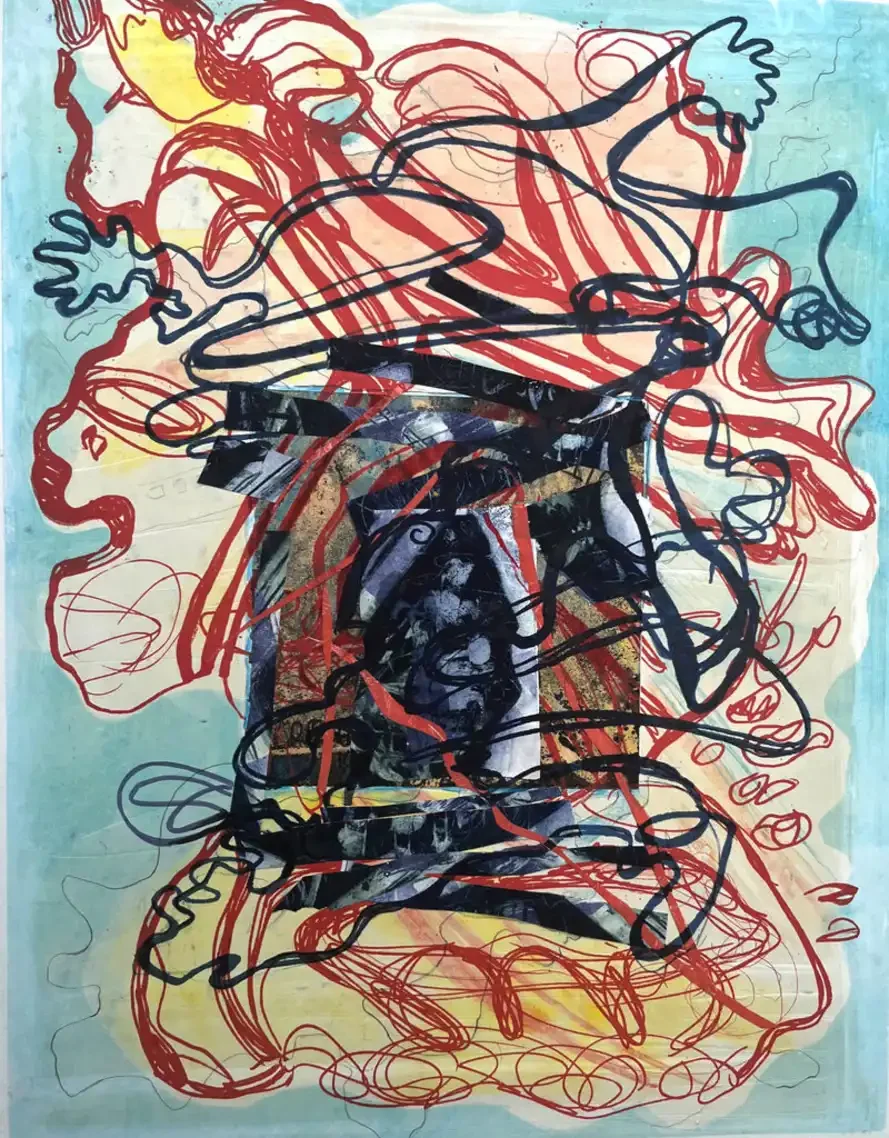
In Rule Like a Dictator, No. 2, a fragmented collage of Donald Trump’s face emerges amid Greco-Roman columns and abstract architectural forms, the classical pillars distorted and destabilized. The funhouse-like repetition of the figure’s features reflects the confusion, spectacle, and cult-like authority of political power. The works in Peters’ Untitled, USA series layer paint, pastels, and archival photographs to depict gun culture and normalized violence embedded in the national landscape. Targets, firearms, and ritualized displays of force occupy both historical and symbolic space, suggesting that the Declaration’s promises are continually negotiated against inherited systems of coercion. The mirroring of the white, macho performance on both ends of the gun brings into sharp relief questions of who is shooting whom. Across these works, Peters maps the ongoing tension between national ideals and the realities of systemic brutality, revealing how authority and its abuses endure across generations.

John Francis Peters, Untitled, USA, No.3, 2023, Mixed Media, Spray Paint, Pastel Dust on Paper, 11x8.5”. Courtesy of the Artist.

The landscapes of Monica J Rich interrogate the Declaration of Independence’s portrayal of Indigenous peoples as obstacles to expansion, highlighting how narratives of emptiness and natural beauty mask histories of displacement and dispossession. The Declaration overtly labeled Native Americans as “savages” to rationalize violence and land seizure. “Many people including the signors of the document thought this gave them the right to destroy these people,” the artist says. “Suffering increased and Native Americans that were not killed were displaced.” The Declaration’s promises of freedom and sovereignty were historically selective, legitimizing settler claims while erasing Indigenous governance and life. Her landscapes operate quietly but insistently, showing how land itself becomes a site of both exploitation and memory, demanding that viewers question designations such as “national treasures” and confront the complex legacies of occupation, stewardship, and narrative control.

In Caumsett State Park Marshland, the marshland appears serene, yet the park’s identity depends on the erasure of the Matinecock Nation, an Algonquian people who have stewarded northwestern Long Island since time immemorial and whose presence has been obscured through colonial dispossession and myth-making. Today, the Matinecock continue as a living nation with ongoing cultural revitalization efforts, even as their stewardship of the land has been overwritten by private estates and state preservation narratives. O‘ahu – Kekoalale Ridge presents lush Hawaiian terrain, the beauty of which is inseparable from settler colonial legacies and modern militarization. This land lies within the homelands of Native Hawaiians (Kānaka Maoli), the Indigenous Polynesian people of the Hawaiian Islands whose cultures and political systems predate colonial annexation and whose displacement and ongoing struggles for self-determination continue to shape the social and economic landscape of the islands. Valley of Fire Environs depicts desert expanses often imagined as untouched wilderness, yet this landscape has long been part of the traditional territories of Southern Paiute (Nuwuvi) peoples, whose deep connections to the land extend across southern Nevada, northern Arizona, and adjacent regions through millennia of cultural, ecological, and spiritual practice. Indigenous presence is rendered invisible when the desert is framed as primordial spectacle rather than as land shaped by Indigenous lifeways and histories of stewardship and resistance.

Monica J Rich, Valley of Fire Environs, 2018, Gouache on Archival 140 LB Hot Press Paper, 9x12”

The drawings and lithographs of Rebecca Shmuluvitz interrogate the structural opacity and ritualized bureaucracy that undermine the promises embedded in the Declaration of Independence. While the Declaration asserts that governments are instituted to secure “life, liberty and the pursuit of happiness,” Shmuluvitz explains the compositions present “anecdotal situations that allude to the absurd and isolating experience of navigating opaque bureaucratic and social systems. Characters and objects in my work are frozen in states of redundancy, inefficiency, caught in crumbling infrastructures, and are often positioned as either a wrench or a cog. They aspire to civil disobedience, though never quite succeed.” The artist’s greyscale compositions amplify the tension between apparent order and the hidden dysfunction, reflecting a society in which ideals of freedom are simultaneously celebrated and withheld.

In Medieval Business Casual, an American flag projects from a building façade, symbolizing both protection and instability. Figures navigate spaces within and without, but do not cross over to the other side. Peer Review (Lion’s Den) captures the emotional labor and scrutiny imposed on marginalized individuals, their identities parsed, constrained, and evaluated within structures that claim fairness but perpetuate exclusion. Wabbit Season, Tax Season (Blood from a Stone) turns attention to economic inequities, depicting unequal taxation and the extraction of value under systems that privilege some while exploiting others. Across these works, Shmuluvitz foregrounds the mechanics of oppression (the “long train of abuses and usurpations” the Declaration enumerates) while emphasizing the quotidian absurdities and emotional toll of navigating inherited systems of authority. The artist explains the tension in the work by suggesting they “hold the viewer at a particular vantage point, unable to reach a resolution as the action continues beyond an architectural threshold or off the edge of the picture entirely.”

Rebecca Shmuluvitz, Wabbit Season, Tax Season (Blood from a Stone), 2025, Plate Lithograph on Paper, 14x11”. Courtesy of the Artist.

The works of Niki Singleton confront the gendered and ideological exclusions embedded in the Declaration of Independence, particularly the foundational erasure of women, gender-nonconforming, and nonbinary people. While proclaiming that ‘all men are created equal,’ Singleton explains the document embedded “patriarchy and control beneath the language of liberty. This foundational omission set in motion centuries of inequality that continue to shape American political, social, and cultural life. Together, these works trace an unbroken line from revolutionary rhetoric to present-day policy. By linking gender, religion, and national identity, they insist on a more honest reckoning with American equality—and a more expansive understanding of who has always deserved it.”

In Doppelgänger, two mirrored female figures stage a confrontation between exclusion and compliance. One figure embodies historically marginalized identities, adorned with symbols of queer and mystical resistance, while the other embodies conformity under patriarchal constraints. “The figures mirror distorted versions of one another,” Singleton explains, “exposing how binary thinking fractures solidarity and sustains unequal power.” The barbed wire, knives, and spectral forces spanning the composition evoke the latent violence required to sustain exclusionary social orders, demonstrating how the Declaration’s ideal of equality was simultaneously aspirational and restrictive. Adam’s Garden reimagines the Garden of Eden, presenting a nonbinary figure among exaggerated vaginal flora. In this work, Singleton states its intention is to challenge “the religious and legal frameworks that shaped the Declaration’s worldview and continue to determine who is recognized as fully human under the law.” Here Come the Canadians! extends Singleton’s critique to contemporary immigration, depicting abstract figures navigating surveillance, detainment, and structural exclusion. Singleton deploys a pointed irony: the category of the “alien” becomes the mechanism through which unalienable rights are withheld. Across these works, Singleton emphasizes that liberty and equality are neither universal nor automatic; they are continually contested, and the Declaration’s promise remains unfinished, necessitating a critical reckoning with both historical and ongoing inequities.

Niki Singleton, Here Come The Canadians!, 2025, Acrylic Ink, Oil Pastel, Glitter on Arches Watercolour Paper, 24x30x0.5”. Courtesy of the Artist.

The project American Words (Specious Ends) by KR Windsor interrogates the contradictions between the lofty ideals articulated in the Declaration of Independence and the historical and ongoing realities of exclusion and inequality. Drawing directly from the text of the Declaration and other documents of foundational American mythology, Windsor uses “interstitial language” (phrases like “that all men are” and “and the pursuit of”) to interrogate the gap between rhetorical promise and material practice. “This written ‘connective tissue,’” the artist explains, “tugs at the concepts they are attached to, begging the question of their truth value today.” Mathematical symbols are employed as visual and conceptual shorthand for what the founders claimed versus what was realized. Each equation, inequality, or negation functions as a measure of historical and contemporary dissonance, making the Declaration’s selective freedoms legible through abstraction and mathematical metaphor.

In American Words (Specious Ends) III, the phrase “that all men are” is paired with a not-equal-to symbol, referencing the contradiction between the Declaration’s universal language and the stratified realities of race, religion, and nationality. Windsor overlays this text with a historical “racial map,” evoking the persistent hierarchies the Declaration helped to entrench. American Words (Specious Ends) IV abstracts the promise of “and the pursuit of” liberty and happiness over imagery of a mundane supermarket aisle, suggesting the uneven accessibility of that pursuit across social and economic contexts. There’s no freedom to fully develop and thrive, nor even freedom to subsist. In American Words (Specious Ends) VIII, the Pledge of Allegiance is invoked alongside the words “and justice for” and a negation-of-set-membership symbol, rendering visible the structural exclusions of immigrants, dissenters, and marginalized communities. Across this evolving series, Windsor’s work underscores the enduring tension between national ideals and lived realities, revealing how the Declaration’s language, even as it aspires to universality, codified a system in which “all” has historically been few.

KR Windsor, American Words (Specious Ends) VIII, 2026, Giclée Print on Hahnemuhle PhotoRag 308, 24x36”. Courtesy of the Artist.

By engaging with the Declaration of Independence not as a static historical document but as a living framework of promises, exclusions, and contested freedoms, A Long Train: 250 Years of Hypocrisy invites viewers to confront the continuities of injustice and the ongoing work of independence. The exhibition foregrounds both critique and creation, highlighting the ways artists refuse inherited narratives, imagine alternative futures, and assert forms of clarity, care, responsibility, and collective life. It is an invitation to reckon with the legacies we inherit, to acknowledge the freedoms still denied, and to imagine what a more just, inclusive, and accountable society could yet become. Independence, if it is to mean anything now, must be practiced, not commemorated. The contradictions remain. Whether we do is the question.

Past Artsy Exclusive Exhibitions