





Hiroko Ohno
Hiroko Ohno is a Brooklyn-based artist originally from Tokyo whose work investigates space, gravity, time, and the relationship between the visible and invisible. Moving between painting, sculpture, and installation, she draws on direct observation, material processes, and contemporary cosmology to question how we locate ourselves within a universe that extends far beyond ordinary human perception.
A formative shift in Ohno’s practice occurred in Mongolia’s Gobi Desert, where she witnessed the setting sun and rising moon simultaneously on opposite horizons. Standing between them, she became physically aware of the Earth—and herself—as suspended in space. The experience transformed her understanding of pictorial space. Rather than treating space as contained within the boundaries of a painting, she began to conceive of its axis as extending beyond the canvas, around the viewer, and outward into a larger cosmic field.
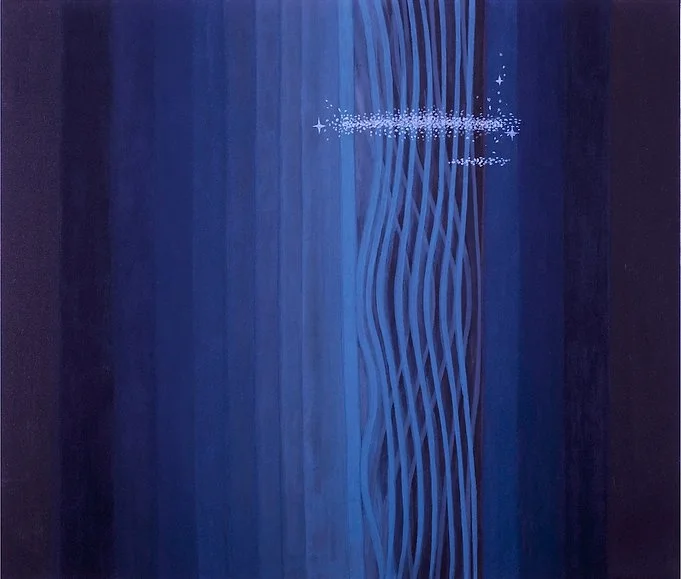
Material is integral to this inquiry. Ohno works with mineral pigments formed through geological processes over millions and billions of years, together with seashells, coral, mica, and other natural materials. For her, these substances carry the compressed history of the Earth, bringing geological and cosmic time into the physical structure of the work. Beneath the deep blue surfaces of her paintings are many layers of luminous crimson, which she associates with the intense heat of the early universe. Although much of this underlying color eventually becomes invisible, it remains physically present as part of an unseen network extending from the origins of the universe into the present. The visible and invisible thus coexist materially within the painting.
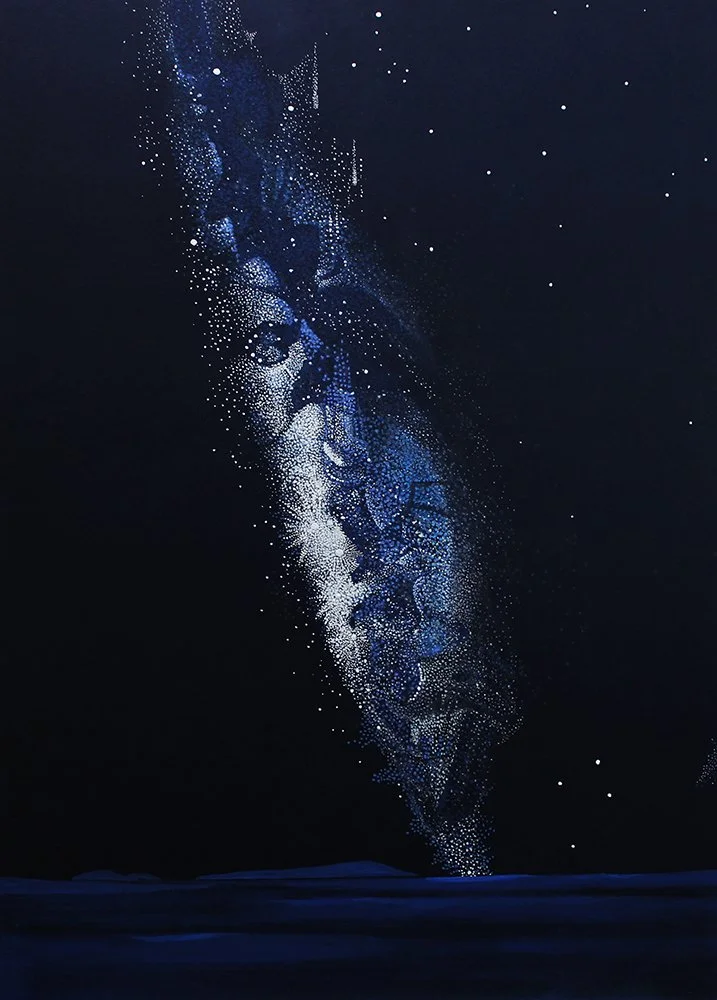
Direct observation and on-site painting are fundamental to Ohno’s practice. Working in environments including Namibia, the Sahara, and the Atacama Desert, she paints the night sky as she observes it, experiencing the movement of celestial bodies and the passage of time as part of the work itself. Watching the sky over time makes palpable not only the movement of the stars but her own position on a rotating Earth. This sustained, embodied way of working also resists a contemporary culture increasingly shaped by speed, convenience, and mediated images. Her visit to the ALMA Observatory brought direct observation into dialogue with technologies that extend perception beyond what the human eye can see.
In works such as Galaxy: Event Horizon, Ohno engages with black holes, gravitational waves, spacetime, and astronomical distance—not as subjects for scientific illustration, but as ways of probing the limits of perception and pictorial space. Different scales, forces, distances, and dimensions coexist within the work, allowing structures that ordinarily remain invisible to become perceptible through painting.
From a cosmic perspective, human existence occupies only a minute place within a vastly larger continuum. Ohno’s work questions the hierarchies through which humans assign value to themselves and to other forms of existence—animals, plants, rocks, water, fire, and celestial bodies. In the context of the Anthropocene, this perspective connects the seemingly remote scale of the universe to questions of environment, value, and human responsibility on Earth.
Born in Tokyo, Ohno holds a BFA and MFA from Musashino Art University. She has exhibited nationally and internationally, including solo exhibitions at Sanagi Fine Arts (Tokyo); Radio House Gallery (NY); Desbrosses Gallery (NY); Homma Museum (Yamagata); and Takashimaya Gallery (Tokyo). Her work is held in collections at University of Tokyo; Keio University; Hiratsuka Museum of Art; Homma Museum; CUNY QCC Art Gallery; and Lyman Allyn Museum.
Publications include Collected Works of Hiroko Ohno (Kyuryudo Art Publishing) and Midori Yamamura’s essay in Women across Asian Art: Selected Essays in Art and Material Culture. Ohno received an Artist Grant for the Vermont Studio Center Residency Program and was selected for the LMCC/Creative Capital Artist Summer Institute and the NYFA Immigrant Artist Mentoring Program.